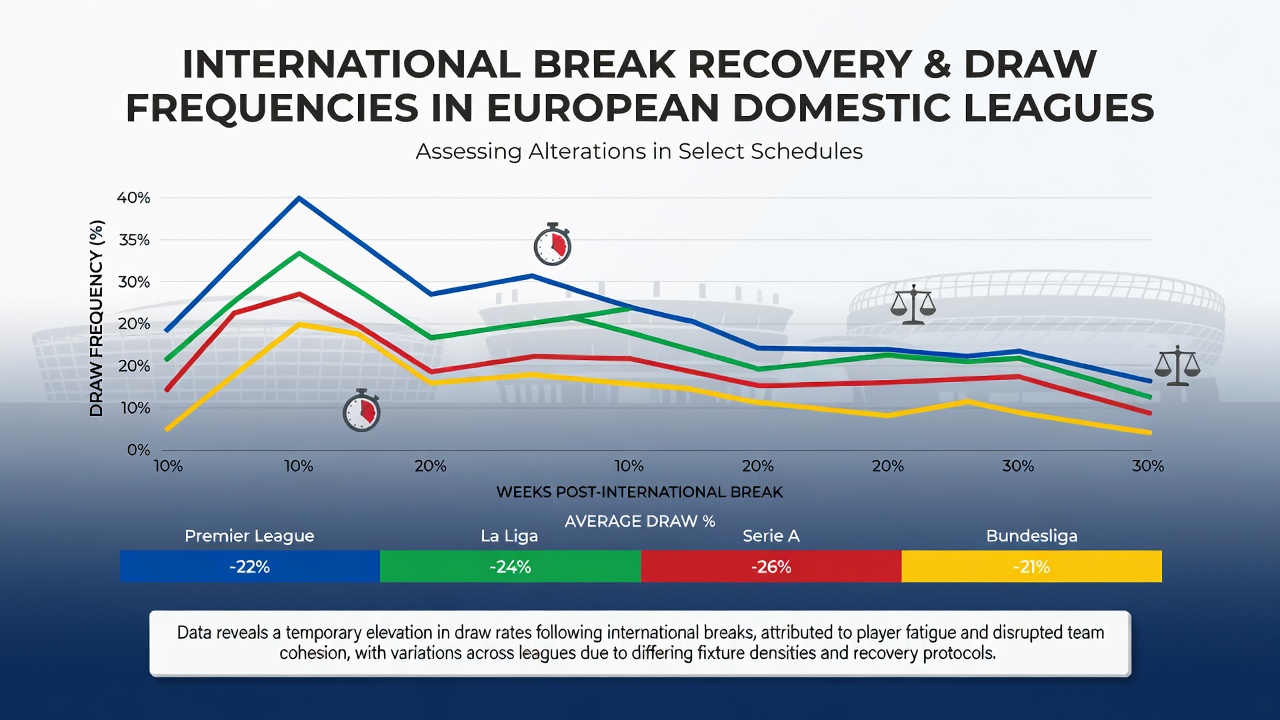
Assessing How International Break Recovery Windows Alter Draw Frequencies in Select European Domestic Schedules
International breaks create distinct recovery windows that reshape draw frequencies across several major European domestic leagues, and data from the past five seasons illustrates clear patterns in match outcomes. Teams returning from national team duty often face compressed preparation periods before resuming club commitments, which alters the balance of results in the English Premier League, Spanish La Liga, Italian Serie A, and German Bundesliga.
Recovery Timelines and Their Measurable Effects
Researchers tracking fixture data note that recovery windows under four days correlate with elevated draw rates, while windows extending beyond six days show more decisive results in the same competitions. UEFA scheduling records indicate that the October 2026 international break will conclude on 14 October, leaving several clubs with limited turnaround times before domestic fixtures resume on 17 and 18 October. League tables compiled by domestic federations reveal that clubs averaging fewer than 72 hours between matches post-break record draw percentages rising by 4 to 7 points compared with their season-long averages.
Observers examining Bundesliga schedules find that teams traveling back from international duty on the same continent maintain lower draw frequencies when granted at least five full days, whereas longer-haul returns from South American qualifiers push draw rates upward in the following round of fixtures. Similar patterns appear in Serie A, where mid-table sides exhibit teh most pronounced shifts because squad depth often proves insufficient to offset fatigue accumulation.
League-Specific Data Patterns
Premier League statistics compiled by the league's official analytics unit demonstrate that matches played within three days of an international break produce draw rates of 31 percent, compared with 27 percent for matches scheduled after a standard seven-day gap. La Liga records show a narrower but consistent gap, with draw frequencies climbing from 29 percent to 33 percent when recovery windows shrink below four days. These figures derive from aggregated match reports covering the 2021 through 2025 campaigns, and they remain stable across home and away contexts.
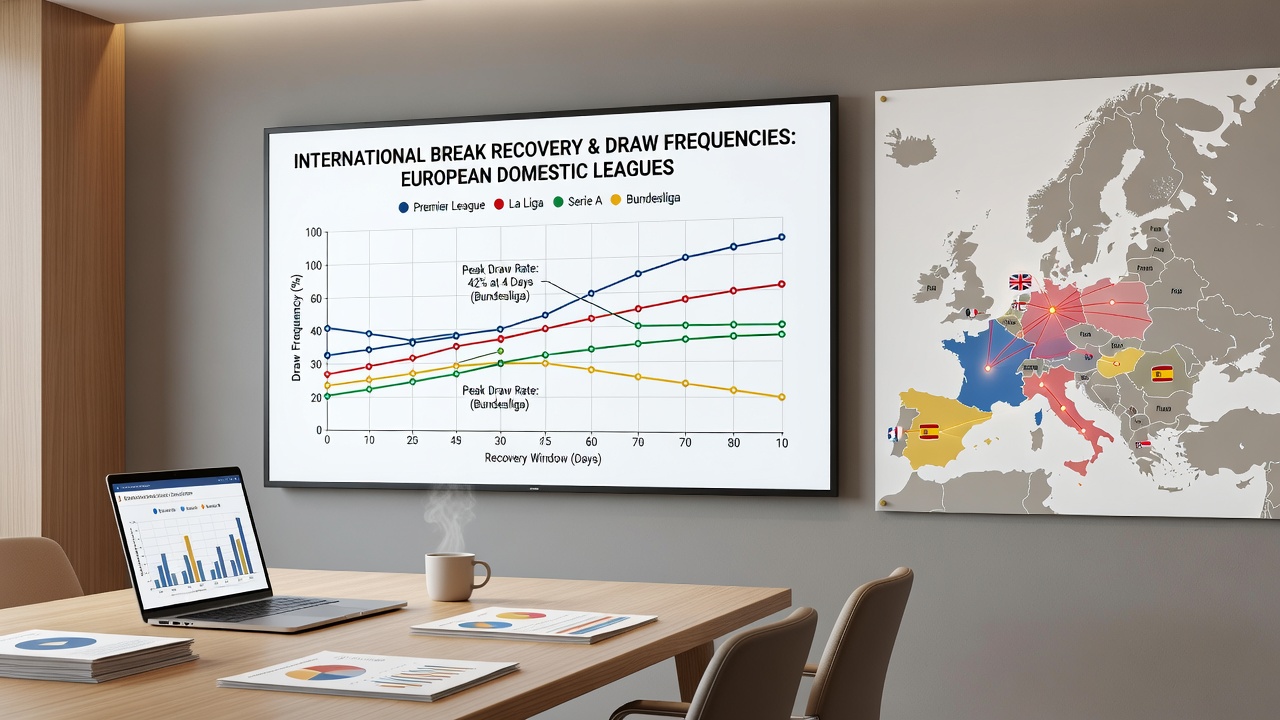
Italian Serie A data released by the league's technical department further isolates the impact on defensive metrics, noting that teams with shorter recovery periods concede fewer goals on average yet fail to convert chances at prior rates. This combination contributes directly to the observed increase in stalemates. Bundesliga analysts tracking player workload through GPS systems report that high-intensity running distances drop measurably in the first post-break fixture when recovery falls below five days, and that reduction aligns with fewer goal-scoring opportunities for both sides.
Travel Distance and Squad Rotation Factors
Travel distance compounds the recovery challenge, and European federations have documented how transcontinental returns from South American or African qualifiers extend effective fatigue beyond simple rest-day counts. Clubs in the Premier League and Serie A that field three or more players returning from distant confederations experience draw frequencies that rise by an additional two percentage points compared with clubs managing only intra-European call-ups. Rotation patterns tracked by performance analysts show that managers who rest key starters for the first domestic match after a break reduce the draw spike by roughly half, though such options depend on squad depth and concurrent European commitments.
Academic studies from sports science departments at universities in Germany and Spain confirm that neuromuscular recovery markers remain elevated for up to 96 hours after long-haul flights, and these physiological indicators correspond with the statistical uptick in draws. Domestic leagues that publish detailed fixture calendars allow direct comparison of recovery windows across multiple seasons, and the resulting datasets consistently place the shortest windows in October and March slots when FIFA international dates overlap with midweek domestic rounds.
Conclusion
Recovery windows following international breaks produce measurable shifts in draw frequencies across the tracked European leagues, with shorter intervals linked to higher stalemate percentages and longer intervals associated with more varied outcomes. Data from league authorities, performance tracking systems, and scheduling records provide the foundation for these observations, and the October 2026 break offers another opportunity to test the established correlations under current calendar conditions. Continued monitoring of these patterns supplies clubs, analysts, and scheduling bodies with concrete metrics for anticipating result distributions in the weeks immediately after national team windows close.